
Three Home Organization Tips That Actually Work


I've been organizing homes professionally in Knoxville for almost six years. I've walked into hundreds of spaces at every level of chaos, and what I keep finding is that the homes that feel the best to live in aren't the ones with the most storage or the prettiest bins. They're the ones where a few small, consistent habits are actually in place.
These are three home organization tips that actually work. Not because they're complicated, but because they're not.
The Two-Minute Rule
My dad passed this one down to me years ago. He learned it from David Allen's book Getting Things Done, and it's one of those ideas that sounds almost too simple until you start using it.
If something takes two minutes or less, do it now. If it takes longer, put it on your list, schedule it, or hand it off.
What I've noticed in my own home is that these small tasks naturally stack at the edges of the day. Ten minutes in the morning: make the bed, unload the dishwasher, start a load of laundry, straighten the sofa. None of it is significant on its own. Together it shifts the entire feeling of the space.
You leave with things in motion. You come back to a home that already feels taken care of.
It's not about doing everything. It's about doing the small things before they become big things.

The $20 / 20-Minute Rule
A few years into this work, I realized I had a rule to give back to my dad.
I call it the $20 / 20-minute rule: if you can replace something for less than $20 and in less than 20 minutes, you can let it go.
This is especially useful for the "just in case" pile. The things sitting in garages and storage bins that you might need someday but probably won't.
My dad had a bag of small pebble rocks in his garage. No real plan for them, just being held onto. When we walked through this rule together, he realized he could replace them in minutes for a couple of dollars. He let them go.
I ask clients a version of this question all the time with random hardware, spare parts, duplicate tools. "If you needed this, would you dig through this bin to find it, or just run to the store?" If the answer is the store, it's probably not worth the space it's taking up.
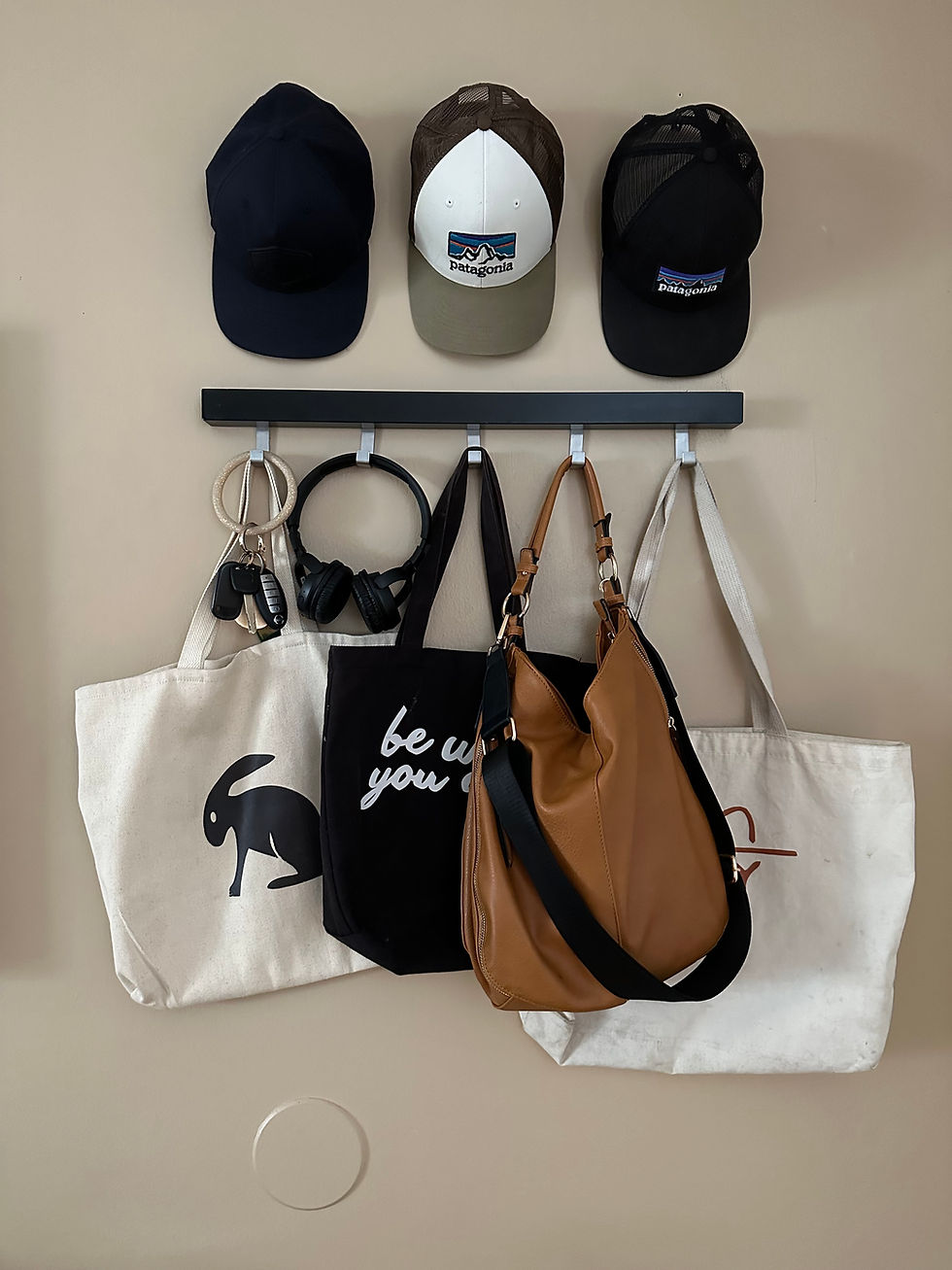
Everything Needs a Home
This is the one that changes things most for people. And it has nothing to do with buying more containers.
Every item in your house needs a designated place to live. Not "somewhere in the kitchen." A specific place.
When something doesn't have a home, it floats. It ends up on the counter, on the chair, on the edge of the table. That floating is what creates the constant low-level feeling of clutter, even right after you've cleaned.
Over time it becomes decision fatigue. Every time you go to put something away, you’re not just putting it away, you’re deciding where it goes. Again and again. That’s exhausting, and it’s why clutter can feel so much heavier than it looks.
It also means you can't see what you actually have. I see clients buy the same thing two and three times because they can't locate what they already own. When everything has a place, you can see it. And when you can see it, you stop over-buying.
When things have a home, putting them away becomes a two-minute task. When they don't, even a simple cleanup turns into another decision.
So the question to ask is: does this have a home?
If the answer is no, you have two options. Create one, or let it go. And the way to decide is simple: do you use it enough, or love it enough, to give it a dedicated place? If not, it's okay to release it. Every item you hold onto takes up space, not just physically but mentally. It becomes one more thing to manage.
A Simple Trick for Finding the Right Home
This one also came from my dad, from David Allen. When you're deciding where something should live, don't overthink it. Put it where your brain naturally reaches for it.
It doesn't have to make sense to anyone else. It just has to make sense to you.
And here's the key: if you go looking for that item later and your instinct takes you somewhere different, that's your answer. Move it. Your brain is telling you where it actually expects that item to be.
The easier something is to find, the easier it is to put away. That's the cycle that slowly, genuinely reduces both clutter and the mental load of keeping a home.
These three rules work together simply. One helps you move through your day. One helps you decide what to keep. One gives everything a place to land.
And when all three are working, your home starts to feel lighter. Not because you did a big overhaul. Because you made a few small decisions and kept making them.
That's what I've found, both in my own home and in the homes I work in every week. The shift isn't dramatic. It just feels really good.
If you're looking for more of this kind of thing — intentional living, a beautiful meal, a reason to slow down together — that's exactly what Date Nite is. One complete evening designed for two, every week. Learn more and try a free Date Nite menu →

About Kevin & Kate
We're Kevin and Kate — a husband-and-wife duo who turned a weekly cooking ritual into something we wanted to share.
Date Nite is our subscription experience for couples: a complete evening every week with dinner, a cocktail pairing, grocery list, playlist, and all the small details that make a night at home feel like something you actually looked forward to. We're glad you found us.
Comments